
For assessing the wavelength accuracy of your spectrophotometer
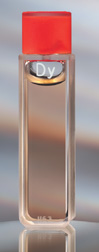
| Description | Didymium (neodymium and praesodymium) perchloric solution permanently heat sealed in a quartz cell |
|---|---|
| Primary Usage | Verify the wavelength scale of UV/visible spectrophotometers |
| Useable Range | 290nm to 870nm, spectral bandpass of 5nm or less |
| Physical Configuration | Far UV quartz cell that has been permanently sealed by heat fusion |
| NIST Traceability | Each set is supplied with a Certificate of Analysis and NIST Traceability |
| ISO Accredited | Accredited by UKAS ISO 17025, ISO Guide34 and ISO 9001 |
Product Description
View/Download Comprehensive Data Sheet for Didymium Oxide Reference
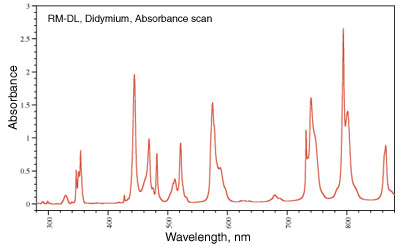
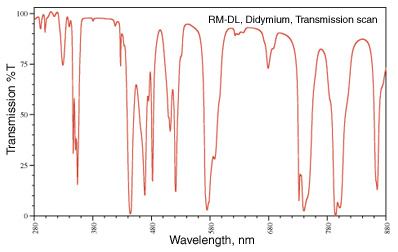
Didymium has been used as a wavelength reference for many years as a glass filter. We now offer a quartz cell filled and permanently sealed with didymium perchlorate solution that will evaluate more effectively the optical performance of your instrument. Didymium offers sharp, stable peaks over the range of 290 to 870nm. Didymium perchlorate is used to assure that the wavelength scale of your instrument is within the manufacturers tolerances to the actual wavelength being measured. The use of the filled quartz cell assures that the optical configuration for your quality control is exactly the same as for a normal analysis.
| UV Region | Visible Region | Visible Region |
|---|---|---|
| 298.0 | 354.0 | 574.9 |
| 329.0 | 444.1 | 731.8 |
| 468.7 | 740.1 | |
| 481.8 | 794.1 | |
| 512.0 | 801.2 | |
| 521.3 | 865.0 |
Suggestions for Use
Didymium presents a wide range of crisply resolvable peaks which are easily used to correlate the wavelength indicator on your spectrophotometer to the known Didymium peaks. The first procedure should be to scan the Didymium Reference against an air blank over the useable range to determine which of the peaks can be resolved by your spectrophotometer.
Add the confidence limit on the Traceable Certificate supplied with the Didymium Reference to the wavelength specification of your instrument, as found in your instrument's user manual, for your target range. Check each peak detected to assure that the reading on your spectrophotometer is within the target range for the wavelength of your spectrophotometer. If not, get a service technician to check and, if necessary, adjust your instrument.
Periodically check the spectra. The periodic use of your Didymium cell will build a log of your instrument's wavelength accuracy for use with certification and troubleshooting should the correlation change over time.
Absorbance Scan of Didymium
Transmission Scan of Didymium
Interpertation of Results
Consult your spectrophotometer's reference manual for the specification of your instrument's wavelength tolerance. This figure will be listed as a plus and minus (+/-) number in nanometers (nm). Add your instrument's wavelength tolerance to the confidence limit on the certificate supplied with the Didymium Wavelength Reference for your expected wavelength range. Compare the wavelength peaks measured on your instrument with the expected values. If the readings are within the expected range for your instrument then your wavelength scale is correct. If not, consult your service techincian and have the instrument evaluated.
Quality program
Each time that the analysis is repeated you can compare the new results with the previous results to check for any changes that exceed the expected range for a peak. If your instrument needs service because of a change in wavelength accuracy, the historical data will greatly assist the service technician.
How to Order
| Catalog Number | Description |
|---|---|
| RM-DL | Wavelength Reference Cell, Didymium, NIST traceable |
Download MSDS Sheet for RM-DL Reference