
For assessing the presence of Stray Light in your UV spectrophotometer
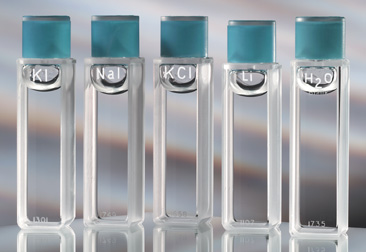
| Description | Materials with sharp cutoffs in transmission at specified wavelengths |
|---|---|
| Primary Usage | Detection of Stray Light |
| Useable Range | 200nm to 390nm, depending on the material |
| Physical Configuration | Far UV quartz cell that has been permanently sealed by heat fusion |
| NIST Traceability | Each set is supplied with a Certificate of Analysis and NIST Traceability |
| ISO Accredited | Accredited by UKAS ISO 17025, ISO Guide34 and ISO 9001 |
Product Description
View/Download Comprehensive Data Sheet for Stray Light Cut-off Filters Reference
Stray light can be described as an indication by the spectrophotometer of transmitted light when in reality there is no light being transmitted through the sample. The presence of more stray light than specified in your spectrophotometer operators manual may cause errors in your analysis. Stray light can be a problem at any wavelength range of the instrument but the problem increases the further into the UV that you will be measuring. The Stray Light Reference Materials are useful in determining the amount of stray light in your instrument because each material stops transmitting light below a specific wavelength. Hence, below a specified "cur-off" wavelength, any indication of light transmission must be stray light. The testing for stray light is important even if the spectrophotometer is not used below 260nm because it is an excellent indication of the overall system health of the spectrophotometer's optics, grating and deuterium lamp.
Stray light determinations are run against a supplied water blank. This blank is supplied with all of our NIST traceable stray light references. The certificate of traceability supplied with stray light references is measured against the water blank supplied with that reference set.
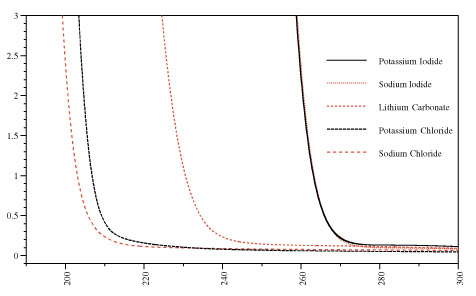
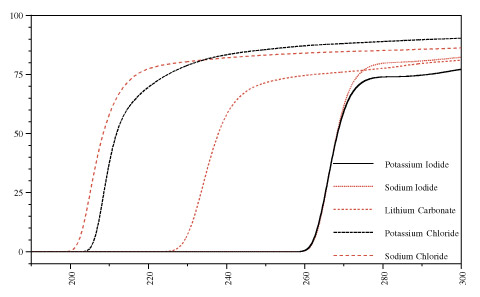
| Material | Cutoff | Concentration |
|---|---|---|
| Potassium Iodide | 260 nm | 1% aqueous |
| Sodium Iodide | 260 nm | 1% aqueous |
| Lithium Carbonate | 227 nm | saturated aqueous |
| Sodium Chloride | 205 nm | 1% aqueous |
| Potassium Chloride | 200 nm | 1.2% aqueous |
| Sodium Nitrite | 391 nm | 5% aqueous |
| Acetone | 326 nm | spectroscopy grade |
Suggestions for Use
The procedure for using the stray light reference is similar for all materials. Set your spectrophotometer's wavelength 20nm above the cutoff for the stray light reference that you are using (for Potassium Iodide you would start at 280nm). Insert the stray light blank cell in the blank cell holder of your spectrophotometer and insert the stray light reference cell in the sample holder of your instrument. Scan down into the UV to the lowest wavelength that your instrument manual specifies as the lowest wavelength that your instrument can read. Any light transmitted below the cutoff wavelength is stray light.
For more information on the technique for using the stray light reference you can view this short pdf document from NIST:
NIST Stray Light SRM
Absorbance Scan of Stray Light References
Transmission Scan of Stray Light References
Interpertation of Results
If the amount of stray light transmitted is greater than specified in your spectrophotometer's user manual, call a service technician to investigate and correct the problem.
Quality program
Periodically rescan with the same instrument configuration and compare the results. Over time you will have a data trail for your spectrophotometer which will make the detection and correction of any problems relating to stray light much more reliable.
How to Order
| Catalog Number | Description |
|---|---|
| RM-KI | Stray Light Reference Set, Potassium Iodide, NIST traceable |
| RM-SI | Stray Light Reference Set, Sodium Iodide, NIST traceable |
| RM-LC | Stray Light Reference Set, Lithium Carbonate, NIST traceable |
| RM-KC | Stray Light Reference Set, Potassium Chloride, NIST traceable |
| RM-SC | Stray Light Reference Set, Sodium Chloride, NIST traceable |
| RM-SN | Stray Light Reference Set, Sodium Nitrite, NIST traceable |
| RM-AC | Stray Light Reference Set, Acetone & Blank Cell NIST traceable |
Download MSDS Sheet for Stray Light References